
EUROPA - Welcome to the homepage of EDGAR
headlinesrss news

Welcome to the homepage of EDGAR

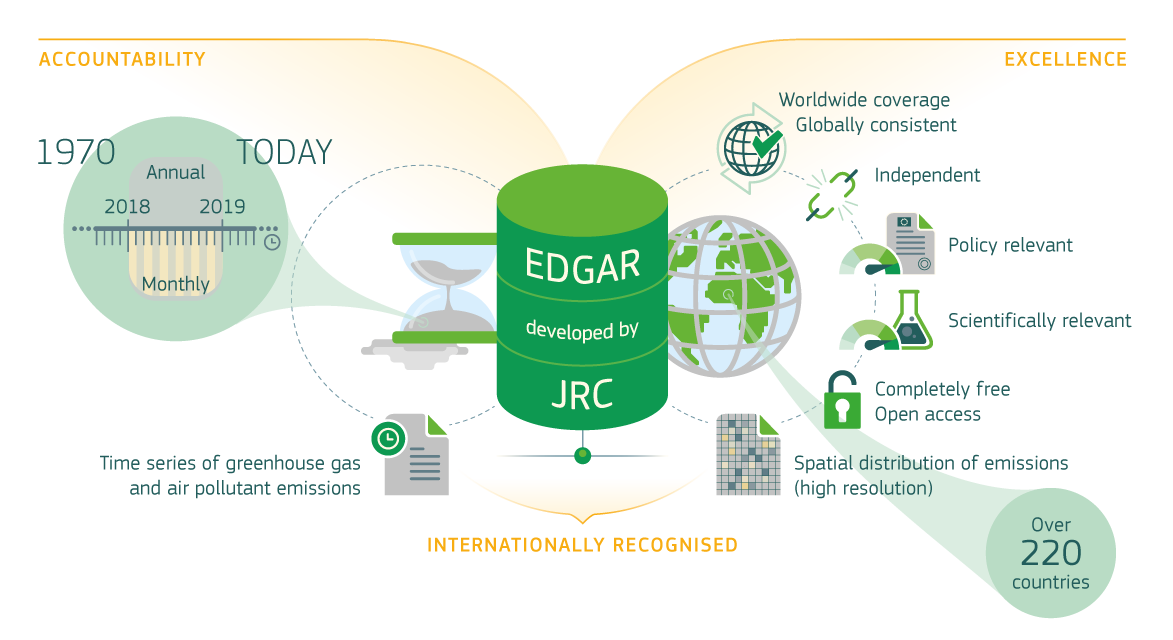
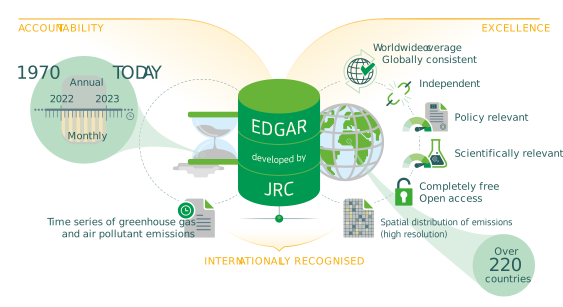
The Emissions Database for Global Atmospheric Research (EDGAR) provides global past and present day anthropogenic emissions of greenhouse gases and air pollutants by country and on spatial grid. The current development of EDGAR is a joint project of the European Commission JRC Joint Research Centre and the Netherlands Environmental Assessment Agency (PBL).

What's new?

11-11-2011
EDGAR v4.2 release
The new version v4.2 of the global EDGAR emissions inventory covers all greenhouse gases included in the Kyoto Protocol (i.e. carbon dioxide, methane, nitrous oxide and the fluorinated gases), ozone precursor gases, and acidifying air pollutants per source category at country level, and gridded with 0.1 deg by 0.1 deg resolution, for the time period from 1970 to 2008. [ Go to dataset ]

21-09-2011
Press releases JRC-PBL: Global CO2 emission trend until 2010.
Global CO2 emission trends from 1970 till 2010 are analysed and the status with regard to the Kyoto Protocol target evaluated. It is concluded that the industrialised countries, although individually showing widely variable emission trends, collectively emitted 7.5% less CO2 in 2010 than in 1990. But their impact on the global picture is increasingly limited, with their share of CO2 emissions having dropped from about two thirds to less than half of the global total since 1990. Increased energy end-use efficiency, nuclear energy and the growing contribution from renewable energy cannot compensate for the globally increasing demand for power and transport, which is strongest in developing countries.
More info in the press release and the background study (long_term_CO2_emission_trend).[ more news... ]

Contact information: greet.maenhout(at)jrc.ec.europa.eu

EDGAR project team
Greet Janssens-Maenhout
European Commission - JRC Joint Research Centre
IES Institute for Environment and Sustainability
CCAQU Climate Change and Air Quality Unit
TP 290
I-21020, Ispra (Va), Italy


JRCThe mission of the JRC is to provide customer-driven scientific and technical support for the conception, development, implementation and monitoring of EU policies. As a service of the European Commission, the JRC functions as a reference centre of science and technology for the Union. Close to the policy-making process, it serves the common interest of the Member States, while being independent of special interests, whether private or national.